Qtree Technologies
Job Assured Java Full Stack Master Program
Master Java Full Stack Development with Core Java, Spring Boot, Hibernate, REST APIs, Microservices, Angular/React, Database Management & Real-Time Projects with Placement Support
Certifications



 Job Oriented Syllabus
Real Time Projects & Hands-On Labs
100% Assured Interview Guarantee
Resume + Interview Preparation
Why Java Full Stack
in 2026
The Java Full Stack Program is a comprehensive, career-focused course designed to build strong front-end and back-end development skills. It covers Core Java, Object-Oriented Programming, Data Structures, Spring Boot, Hibernate, RESTful APIs, Microservices architecture, HTML, CSS, JavaScript, and modern frameworks like Angular/React, along with database management using MySQL. The program also includes Git, CI/CD integration, and deployment strategies. With hands-on real-time projects and practical industry use cases, it prepares learners to become industry-ready Java Full Stack Developers.
Class Formats

Classroom
In-person sessions conducted at our training center.

Online
Instructor-led virtual classes in real time.

Self Paced
Learn anytime with recorded video sessions.

One to One
Learn anytime with recorded video sessions.
Register for Java Full Stack Program
Syllabus
- Introduction to Java
- Working With Java Variables
- Using Operators and Decision Constructs
- Using Loop Constructs
- Creating and Using Arrays
- Create methods with arguments and return values including overloaded methods
- Apply the static keyword to methods and fields
- Create and overload constructors
- Differentiate between default and user defined constructors
- Apply access modifiers
- Apply encapsulation principles to a class
- Determine the effect upon object references and primitive values when passed into methods
- Describe inheritance and its benefits
- Develop code that uses polymorphism
- Override methods
- Differentiate between reference type and object type
- Determine when casting is necessary
- Use super and this keywords
- Use abstract classes and interfaces
- Differentiate checked, unchecked exceptions and errors
- Create try-catch blocks
- Understand how exceptions alter normal program flow
- Advantages of exception handling
- Create and invoke methods that throw exceptions
- Recognize common exception classes
- NullPointerException
- ArithmeticException
- ArrayIndexOutOfBoundsException
- ClassCastException
- Need for JDBC
- JDBC Architecture
- Driver and Application API
- Types of Drivers
- Setting up a project for JDBC
- Establishing JDBC Connection
- Executing Queries
- Transaction Management
- Summary and Quizzes
- Lambda Expressions
- Default Methods
- Functional Interfaces
- Method References
- Stream vs Lambda Expression
- Introduction to J2EE
- Client Server Architecture
- URL, Port Number, Request, Response
- Need for Servlets
- Servlet Fundamentals
- Setting up Web Project in Eclipse
- Configuring and Running Web App
- GET and POST Requests
- Servlet Lifecycle
- Forwarding and Redirection
- Idempotent Requests
- Initialization Parameters and Attributes
- Need for Conversational State
- Session Management Basics
- Cookies
- URL Rewriting
- Session Object APIs
- Listeners in J2EE
- Filters in J2EE
- Summary and Quizzes
- Need of JSP
- Creating and Running JSP
- JSP Lifecycle
- Scriptlets
- Expressions
- Declarations
- JSP Standard Actions
- JSP Directives
- JSTL Overview and Usage
- Summary and Quizzes
- Types of Software Architectures
- SOA and Monolith Architecture
- Why Microservices
- Microservice Architecture Layers
- App Layer
- Business Layer
- Enterprise Layer
- Infra Layer
- Need of Spring Boot
- Difference between Spring and Spring Boot
- Advantages of Microservices
- Normal Spring Manual Approach
- Maven Overview
- Spring Initializer
- STS
- Eclipse with STS Plugin
- Spring Boot Auto Configuration
- H2
- Derby
- HSQL
- Redis Cache
- Postman
- Swagger
- CRUD Operations
- MySQL
- PostgreSQL
- Crud Repository
- JPA Query Concepts
- NamedQueries
- QueryAnnotation
- AsyncResults
- Pagination and Sorting
- Production Monitoring
- Health Check Concepts
- Security Measurements
- Logging Levels
- Pattern Changes
- Rolling Logs
- Multiple Properties
- YML File
- Command Line Runner
- Real Time Scenarios
- Conditional Flow
- Customize Conditional Annotations
- Built-in Conditional Annotations
- Web Application Example
- Validation
- Internationalization (i18n)
- Spring MVC
- Spring RESTful
- Embedded Servers
- Customization
- Basic Authentication
- Form Based Authentication
- Authorization
- Role Based Access Control
- Attribute Based Access Control
- LDAP Based Security
- SSL Security
- TLS Security
- HTML 4.01 Fundamentals
- HTML Elements
- HTML Forms
- HTML Media
- HTML5 Structure
- New Input Types
- Form Validation
- Audio and Video
- Canvas
- Responsive Design
- Media Tags
- CSS 2.1 Fundamentals
- Box Model
- Positioning
- Flexbox
- Selectors and Pseudo Classes
- Transitions
- Transforms
- Animations
- Media Queries
- Responsive Layout
- Accessibility
- JavaScript Basics
- AJAX
- Variables and Objects
- Functions
- Loops
- Events
- DOM Manipulation
- Form Validation
- Cookies
- Dates and Times
- Sliding Menus
- Pop-up Menus
- Slideshows
- Stylesheet Switcher
- ES6+ features: let, const, arrow functions, template literals
- Optional chaining & Nullish coalescing
- Dynamic imports & Top-level await
- Async/Await with Fetch API
- ES Modules in modern bundlers
- Concurrent rendering & Automatic batching
- createRoot API vs legacy ReactDOM.render
- Project setup with Vite
- Debugging with React DevTools
- JSX deep dive (expressions, attributes, children)
- Conditional rendering (ternary & logical operators)
- Fragments & shorthand syntax
- Functional components
- Class components (legacy understanding)
- Pure components & memoization
- Component composition patterns
- useState & useReducer
- Props validation (PropTypes vs TypeScript)
- Default props & destructuring
- Rendering lists with map
- Unique keys & performance considerations
- List virtualization (React Window)
- Synthetic events
- Passing arguments to handlers
- Performance optimization with useCallback
- Lifecycle methods vs Hooks
- useEffect for side effects
- useMemo, useRef, useLayoutEffect
- Custom hooks
- Controlled vs Uncontrolled components
- Form validation (Formik, React Hook Form)
- Using refs for DOM access
- React Router v6+
- Nested routes & dynamic params
- Data APIs (v6.4+)
- Navigation guards
- Redux Toolkit
- Context API
- Zustand, Jotai, Recoil
- Redux Thunk vs Redux Saga
- Suspense for data fetching
- GraphQL integration (Apollo, Relay)
- Jest & React Testing Library
- Cypress (E2E testing)
- Snapshot testing
- React.memo & useMemo
- Lazy loading & code splitting
- Virtualization (React Window, React Virtualized)
- Profiling with React DevTools
- Error boundaries
- React Portals
- startTransition
- Server Components
- Webpack (legacy understanding)
- Vite, ESBuild, Turbopack
- Tree shaking, HMR, Code splitting
- SSR concepts
- Next.js 14+ App Router
- Streaming & Edge rendering
- SSG vs SSR
- Hybrid rendering
- AI-powered UI components
- Micro-frontends
- Edge-first deployment (Vercel, Netlify)
- React Native synergy
- Eco-friendly coding practices
Join our community to get updates about job opportunities, hiring drives, important announcements, and exclusive insights — all completely FREE.
Join WhatsApp CommunityWhat You Will Build During the Course
E-Commerce Website with Cart & Secure Checkout System
Online Food Ordering & Delivery Application
College Admission Management System
Gym Membership Registration & Online Payment Portal
Advanced Todo / Task Management CRUD Application
AI Integrated Smart Web Application (Chatbot, Recommendation System or Automation Feature)
Program Benefits
100% Job Assistance until you are placed.
Hands-on project training with project building (3 to 5 projects).
Dedicated individual placement communication (no WhatsApp group notifications).
Corporate curriculum updated every year based on previous hiring trends.
Interview preparation (Aptitude, Communication, and Online Assessments).
Multiple mock interview rounds (based on current and previous experience).
ATS-friendly CV optimization (Naukri and LinkedIn).
Profile boosting strategies for job-search platforms.
Free LMS access for one year (CV preparation and self-assessments).
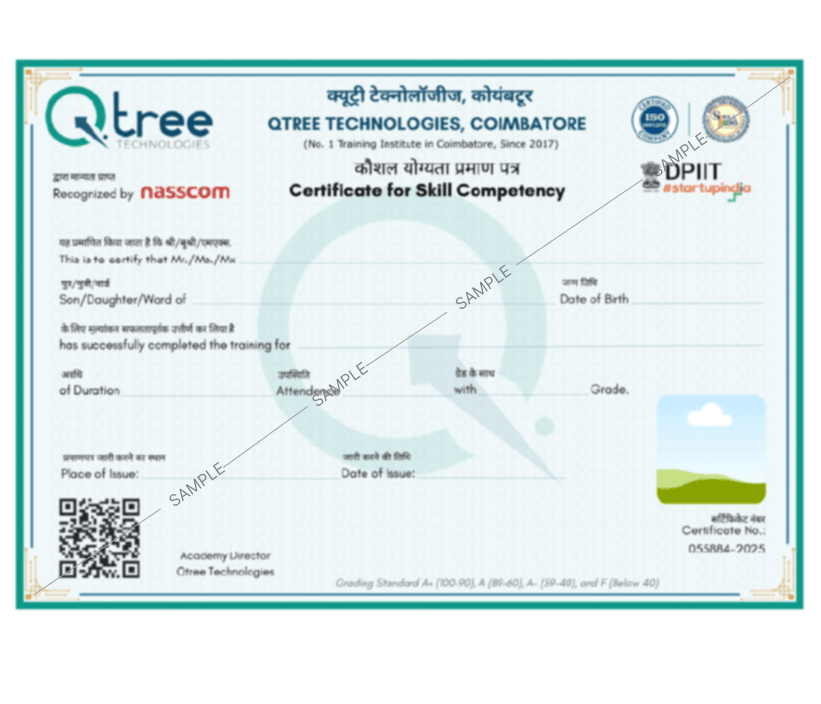
Registered and authorized course completion certificate with ISO standards and government recognition, available for lifetime verification.

Voices of Our Learners


Hiring Companies































































FAQ for Java Full Stack Program
The Java Full-Stack course is intended to foster comprehension you might interpret front-end, middleware, and back-end advancements. You will figure out how to assemble a start-to-finish application, test and convey code, store information utilizing MongoDB, and significantly more.
The fundamental obligations and obligations of a Java full-stack engineer are to configure back-end design utilizing different innovations. Build front-end technologies to create user interfaces. Build adaptable applications and sites according to the client and end-client inclinations.
Full stack Training alludes to the whole profundity of a PC framework application, and full stack designers ride two separate web improvement spaces: the front end and the back end.
- Assessments - Our training pattern includes conducting frequent assessments to understand your technical competence & brief your areas of improvement, during the tenure of the course.
- Interview Questionnaire - At QtreeTechnologies, a dedicated team is available to collate the frequently asked questions in the Top MNCs, and will share the questionnaire with our candidates.
- Mock Interviews - At the end of the course, a team of highly qualified real-time IT technical experts from the industry assess your knowledge of the language, by conducting interviews, and sharing the feedback so you can crack the interview with confidence & ease.
- Resume Building Services – Expert trainers guide our candidates on Resume preparation which will profoundly help you put your career on track.
The job of a full stack designer is to construct total web applications including frontend, backend, and information base administration.
Core Java Classroom Training in Coimbatore:
- Regular classroom-based training: 4 months, 60 minutes of Practical + Theory sessions per day.
- Fast Track (1-1): 60 days.
- Choose your options for weekday or weekend classroom training.
The requirement for full-stack developers is increasing each and every day. They are experts in all aspects of technology. They have aptitude in front-end, back-end, and data set advances.
Explore the Program in Detail
Get complete information about the course and career opportunities.